The Four Seasons, Explained for Kids
Last updated:
A year has 12 months and 4 seasons, with 3 months in each. In the Northern Hemisphere school-calendar grouping: winter is December–February, spring March–May, summer June–August, autumn September–November.
One year, four seasons, three months each
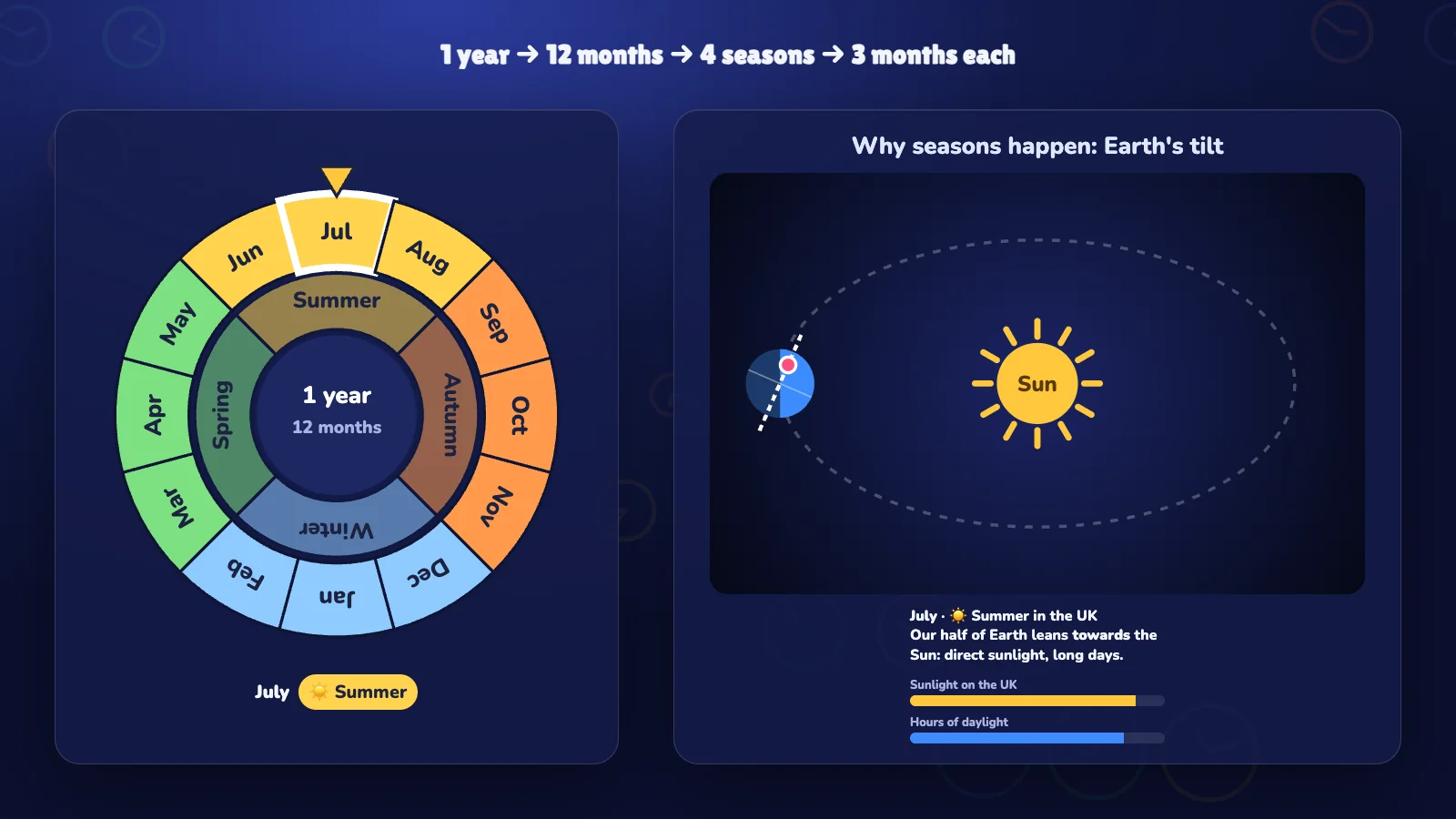
Picture the year as a wheel with the 12 months around the edge. Cut the wheel into four equal parts and each part holds 3 months, because 12 ÷ 4 = 3. Winter starts in December and carries on into the new year, through January and February. Then come spring (March, April, May), summer (June, July, August) and autumn (September, October, November).
The order of the seasons
The seasons always go round in the same circle: winter → spring → summer → autumn → winter again. Turning a year wheel forwards and backwards — month by month — helps children see that the order never changes, only where on the wheel we happen to be.
Why do we have seasons?
The Earth is tilted, and the tilt always points the same way in space as the Earth travels around the Sun. For part of the year our half of the Earth leans towards the Sun: sunlight hits us more directly and the days are longer, so it is warmer — that is summer. Six months later our half leans away: the sunlight is more slanted, the days are shorter, and it is winter.
A very common mix-up: summer is not caused by the Earth being closer to the Sun. In fact, the Earth is closest to the Sun in early January — during winter in the UK. And when it is summer here, it is winter in Australia. If distance were the reason, everyone would have summer at the same time.
School-calendar seasons and astronomical seasons
This guide (and the game) uses the simple school-calendar grouping of three whole months per season. Astronomers define the seasons using the Earth’s position relative to the Sun, so their seasons start around the 20th of March, June, September and December instead. Both describe the same yearly cycle; the calendar grouping is just easier to learn first.
Months aren’t all equal
Seven months have 31 days, four have 30, and February has 28 — or 29 in a leap year, which comes every four years. That is why a month is “about four weeks”, never exactly. More calendar questions are answered in the FAQ.
Try at home
- Season sorting. Write the 12 months on cards and sort them into four season baskets — three cards in each.
- Torch and ball. Shine a torch on a ball held at a slant. Where is the light brightest? Which part gets the slanted light?
- Birthday seasons. Which season is each family member’s birthday in? Which season comes next?
Related: elapsed time.