How Place Value Quest Works
Last updated:
Place Value Quest is built around one idea: a child should see what a number is made of before working with the written digits.
Concrete → visual → abstract
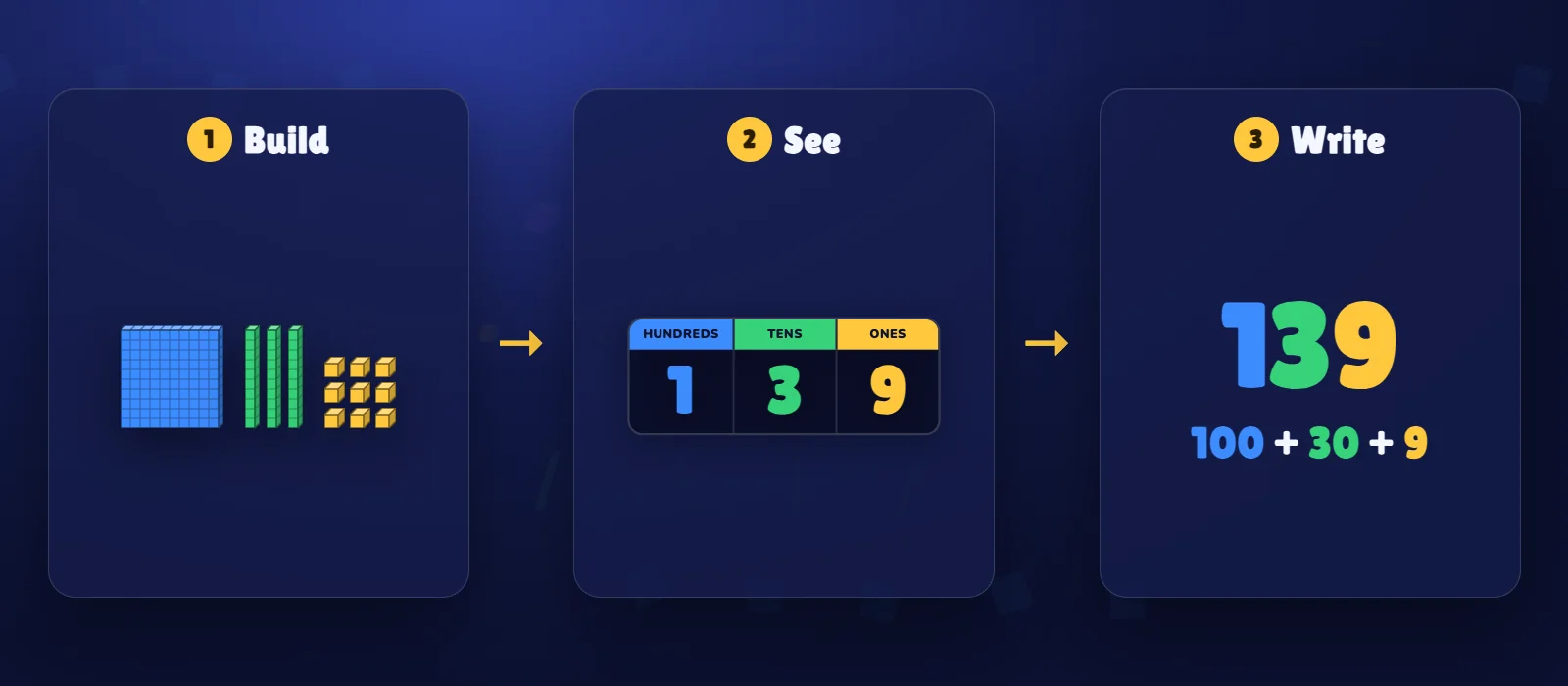
For 139, your child first moves 1 hundred block, 3 ten-rods and 9 one-cubes onto a mat and says what number they built. Then the digits fly out of the columns onto a hundreds-tens-ones board. Only then does the game show 100 + 30 + 9 = 139, and your child taps each digit to hear what it is really worth.
Multiple representations
The same number appears as blocks, as a place-value board, as parts, as words and as digits — side by side, so children learn they are all the same quantity. Larger numbers switch to place-value counters when blocks would be too big to carry.
Immediate, friendly feedback
When an answer isn’t right, the game looks at which wrong answer was given. Writing 13 for 139 gets a different explanation from writing 1009 for 109. There is no “wrong!” and no timer — just a hint, a second try, and a walkthrough if needed.
Progressive difficulty across 10 worlds
Numbers grow in small steps — 139, then 246, then 508, then 1,234 — rather than jumping from small numbers to huge ones. Questions get harder only after a run of clean answers, and easier again after a couple of misses.
Mistakes as part of learning
A mistake is followed straight away by a similar question, so the child gets to use what they just learned. Correcting a mistake earns a bonus.
Built for replay
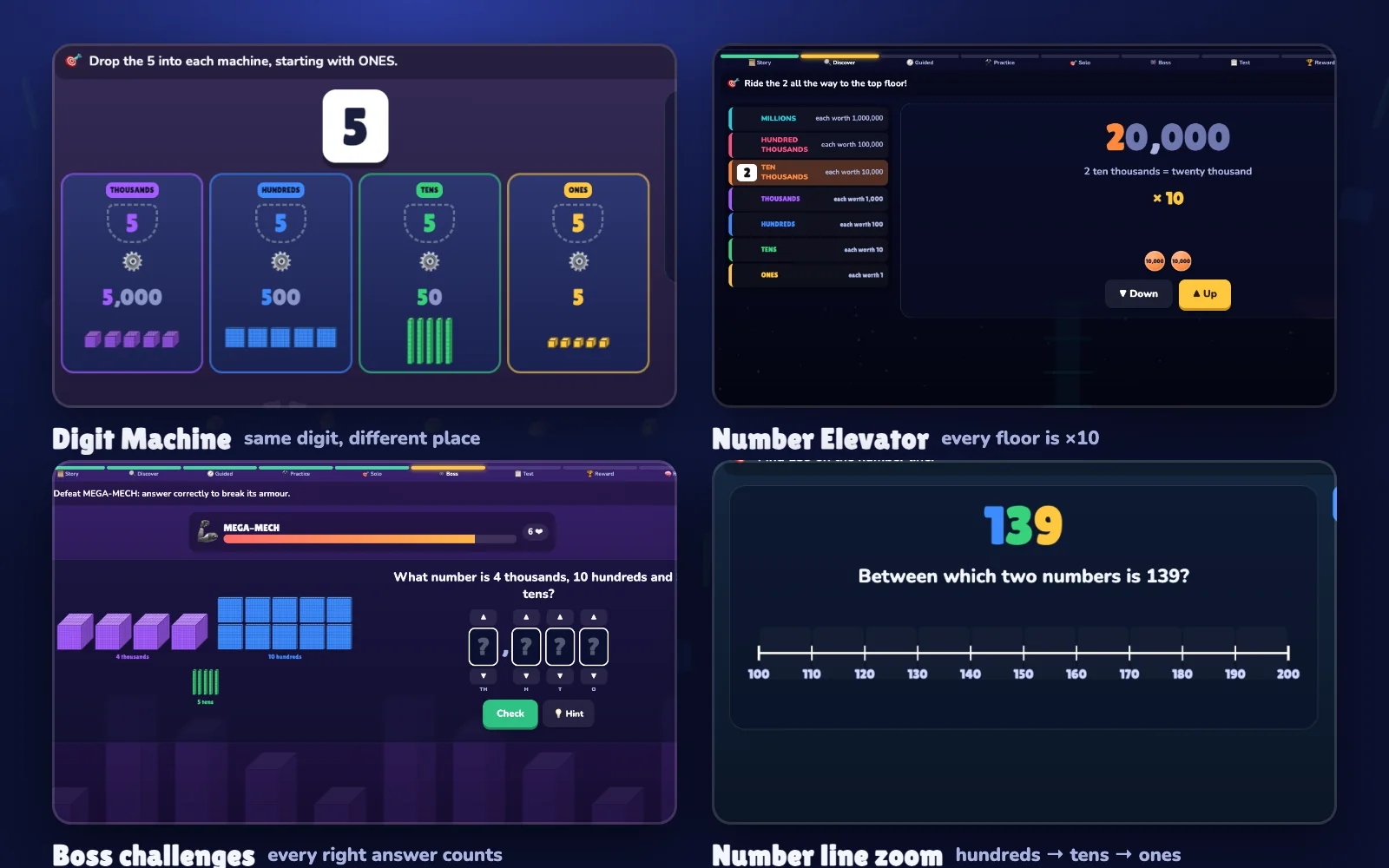
Practice mixes in questions from earlier worlds so older ideas keep coming back. The Training Grounds offer mini-games such as the Digit Machine, the Number Elevator and Zero Patrol, and a parent area shows which skills are strong and which need more practice.
Want the background? Read the research behind it, or the guide for parents and the FAQ.