Helping Your Child Understand Place Value
Last updated:
If your child can read “139” but freezes when asked what the 3 is worth, you are not alone. Place value is one of the ideas that everything else in primary math rests on, and it is easy to look as if you understand it without really doing so.
Memorising a number isn’t understanding it
A worksheet can be finished correctly today and forgotten tomorrow. That usually means the child learned a routine (“write the digits in the boxes”) rather than a picture of what a number is made of. Once a child can see 139 as 1 hundred, 3 tens and 9 ones, the routines start to make sense on their own. For a refresher on the idea itself, read what is place value.
Signs your child needs the model, not more drills
- Reads 139 correctly but can’t say what the 3 means
- Thinks 139 might equal 1 + 3 + 9
- Gets lost as soon as a zero appears (105, 1,005)
- Writes “one hundred and five” as 1005
- Finds thousands random rather than “ten hundreds”
Five games to play at home
1. The ten-bundle game
You need: 20–30 straws, pencils or pasta, and some elastic bands.
How to play: Tip out a pile and count together. Every time you reach ten, band them into a bundle.
What to ask: “How many bundles? How many loose? So what’s the number?”
Watch for: the moment your child sees that 2 bundles and 4 loose is 24.
2. Build it
You need: bundles of ten and loose items.
How to play: Say a number — “can you build 347?” — and let your child build it.
What to ask: “Which digit told you how many bundles of a hundred?”
Watch for: starting with the biggest place first.
3. Digit swap
You need: three digit cards, e.g. 3, 4 and 7.
How to play: Make 347, then swap two cards to make 374.
What to ask: “What changed? Which digit is worth more now — and why?”
Watch for: the answer “its place changed”, not “the number got bigger”.
4. The zero challenge
You need: paper and a pencil.
How to play: Write 105, 150, 1,005 and 1,050. Read each aloud, place by place.
What to ask: “How many tens does 105 have?” (Zero — and that’s fine.)
Watch for: treating the zero as a place holder, not as “nothing to say”.
5. The thousands challenge
You need: anything you can group in hundreds — paper clips in cups, for example.
How to play: Build 1,234: one group of ten hundreds, then 2 hundreds, 3 tens and 4 ones.
What to ask: “How many hundreds are inside the thousand?”
Watch for: realising a thousand is ten hundreds, not a new kind of thing.
When worksheets help — and when to step back
Worksheets are useful for fluency once the idea makes sense. If your child starts guessing, step back to smaller numbers and real objects. A few minutes of building beats a page of boxes. You can also write numbers as parts together using expanded form explained.
A free interactive version of these ideas
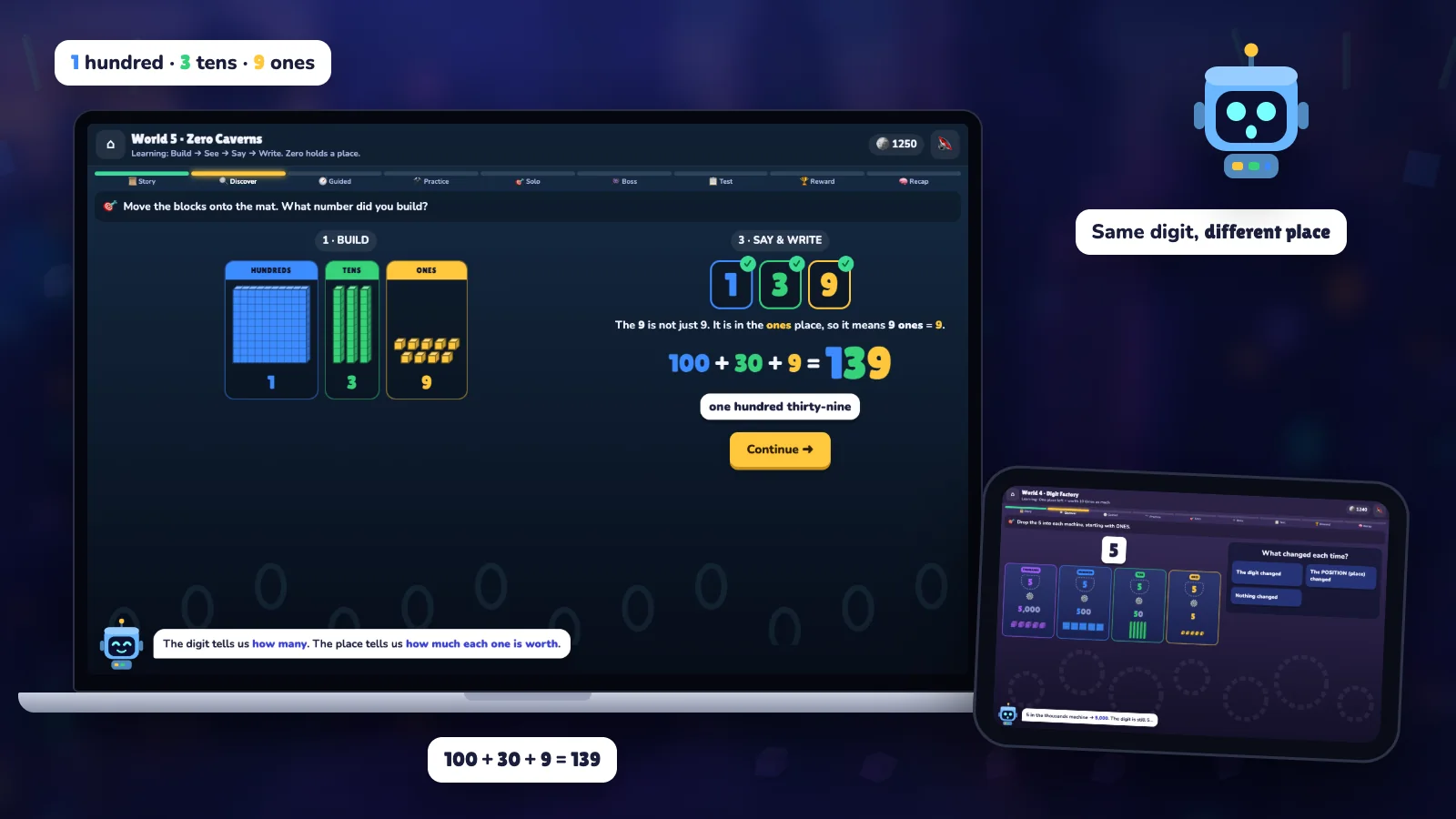
Place Value Quest turns these same activities into a game: children bundle ten cubes into a rod, build numbers from blocks, watch a digit change value in the Digit Machine, and hunt down tricky zeros. It is free, with no signup and no account. Find out how the game teaches, or read the common questions.