Hundreds, Tens and Ones Explained
Last updated:
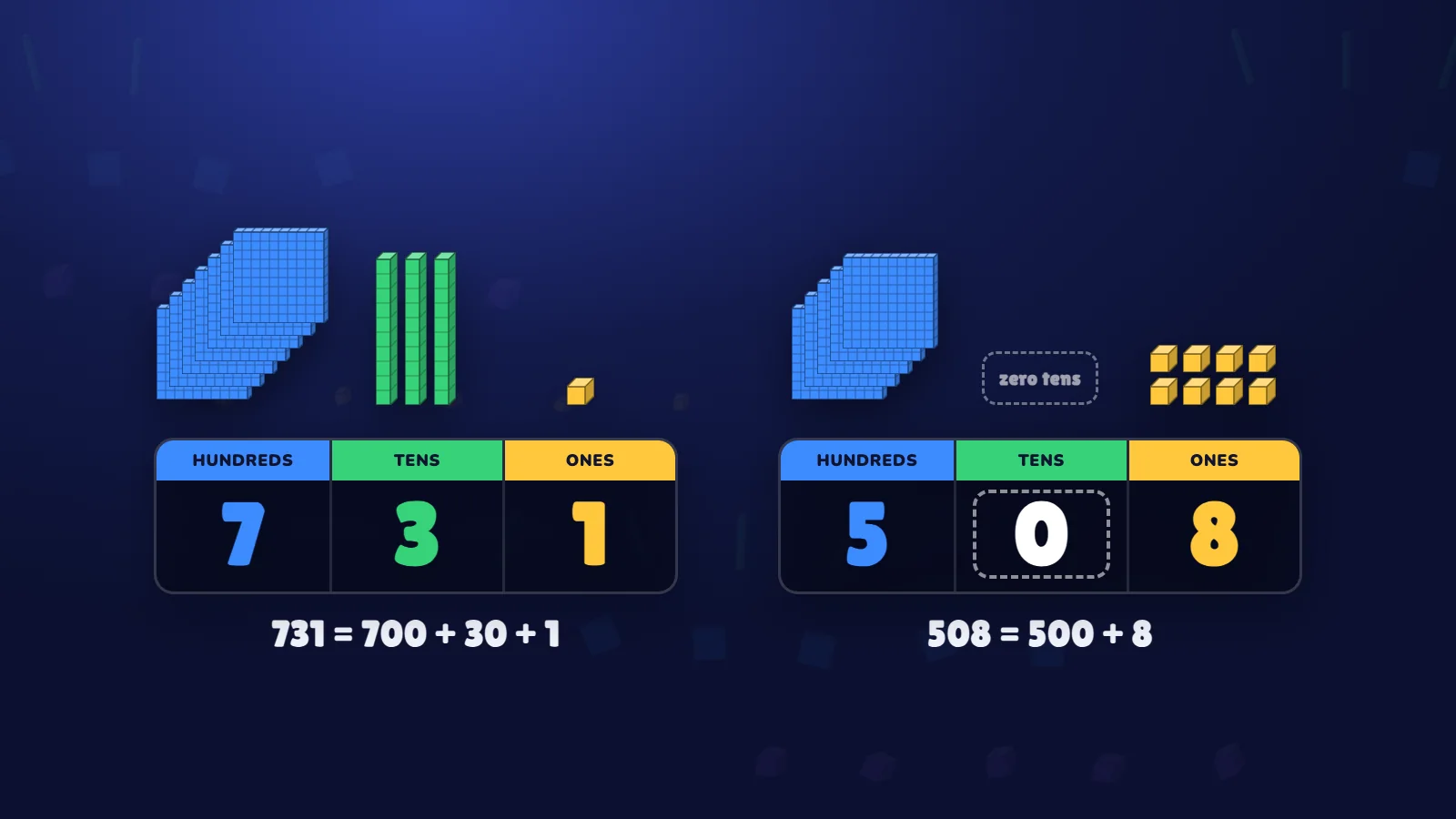
In a three-digit number, the right-hand digit counts ones, the middle digit counts tens (groups of 10) and the left-hand digit counts hundreds (groups of 100). So 731 is 7 hundreds, 3 tens and 1 one.
Ones
The ones place counts single items, from 0 to 9. Think of one small cube. Nine ones is the most this place can hold — one more and you have a ten.
Tens
The tens place counts groups of ten. Ten ones joined together make one ten-rod. The 3 in 731 means 3 tens, which is 30.
Hundreds
The hundreds place counts groups of a hundred. Ten tens make one hundred — a flat square of 100 cubes. The 7 in 731 means 7 hundreds, which is 700.
Putting them together
- 42 = 4 tens and 2 ones = 40 + 2
- 139 = 1 hundred, 3 tens and 9 ones = 100 + 30 + 9
- 731 = 7 hundreds, 3 tens and 1 one = 700 + 30 + 1
- 508 = 5 hundreds, 0 tens and 8 ones = 500 + 8
508 is the tricky one. Say it out loud with your child: “five hundreds, zero tens, eight ones”. The 0 is not “nothing” — it tells us there are no tens, and it keeps the 5 in the hundreds place.
Trading up: 10 of one makes 1 of the next
A place can only hold 0 to 9. When you get 10, you trade them for one of the next place: 10 ones → 1 ten, and 10 tens → 1 hundred. Thirteen ones becomes 1 ten and 3 ones — which is why we write 13. The same rule carries on into understanding thousands.
Try at home
- Bundle the straws. Count out 13 straws or pencils, band 10 together and ask, “How many tens? How many ones?”
- Build it. Write 347 on digit cards. Can your child build it with bundles and singles? Then swap two cards and build the new number.
- Find the zero. Build 508 and ask, “Where are the tens?” The answer “there aren’t any” is exactly the point.
New to the idea? Start with what is place value.