What Is Place Value?
Last updated:
Place value is the value of a digit based on where it sits in a number. In 139, the 3 means 30 because it is in the tens place — the same digit would mean 3, 300 or 3,000 if it sat in a different place.
The same digit, different values
A digit on its own only tells you how many. Its place tells you how much each one is worth. Move a 7 one place to the left and it becomes worth ten times as much.
| Number | Where the 7 is | What the 7 is worth |
|---|---|---|
| 7 | ones place | 7 |
| 70 | tens place | 70 |
| 700 | hundreds place | 700 |
| 7,000 | thousands place | 7,000 |
Breaking down 139
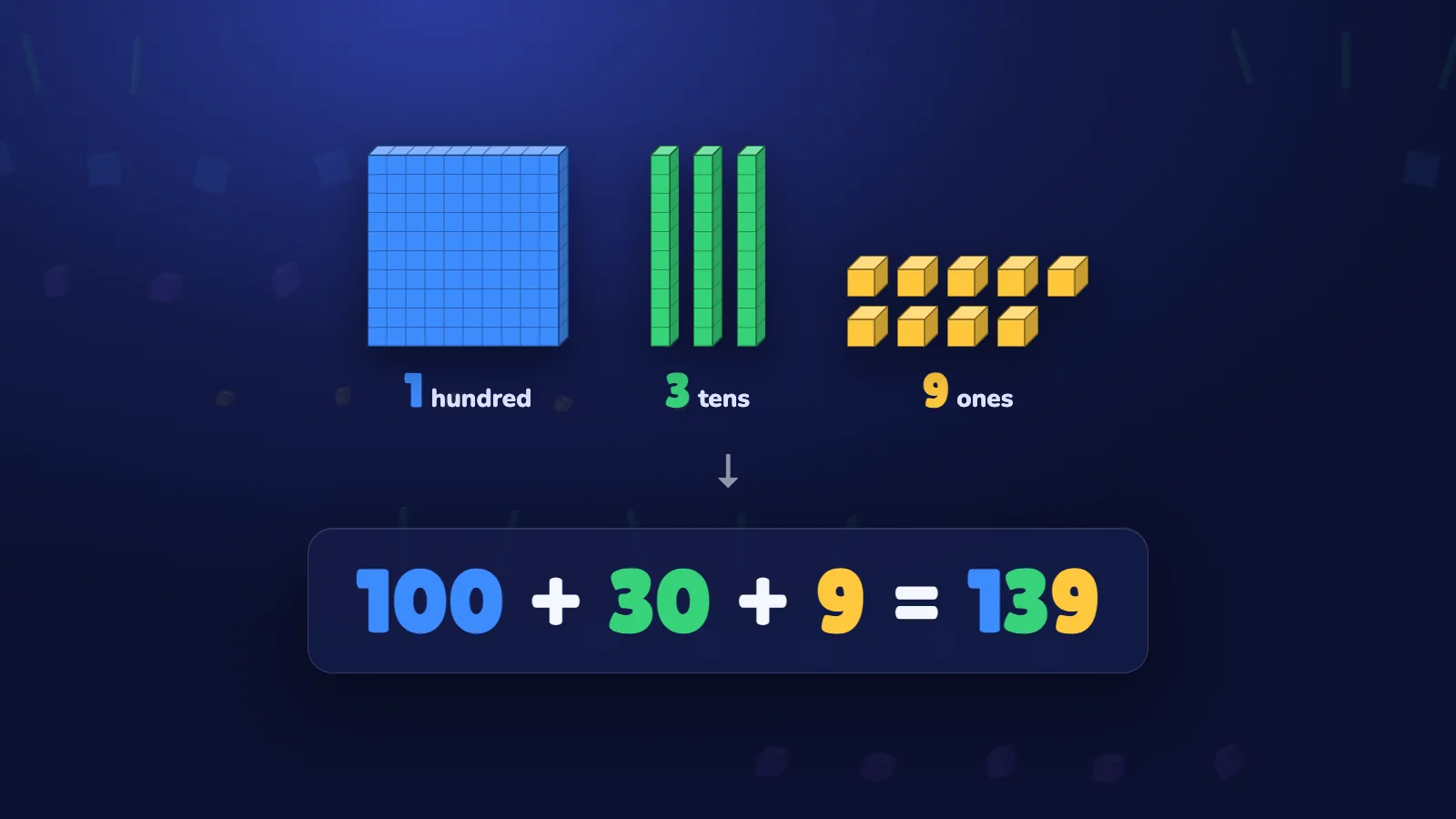
139 is made of 1 hundred, 3 tens and 9 ones. Written as parts, that is 100 + 30 + 9 = 139. This is why 139 is not 1 + 3 + 9: each digit stands for a different-sized group.
Breaking down 1,394
1,394 is 1 thousand, 3 hundreds, 9 tens and 4 ones: 1,000 + 300 + 90 + 4 = 1,394. The pattern never changes as numbers grow — each place is worth ten times the place to its right. See hundreds, tens and ones for the three smaller places, and expanded form for writing numbers as parts.
A simple way to remember it
The digit tells you how many. The place tells you how much each one is worth.
Questions children often ask
Why isn’t 139 just 1 + 3 + 9?
Because the digits are not all ones. The 1 is one hundred and the 3 is three tens. Adding 1 + 3 + 9 treats every digit as ones, which gives 13 — a much smaller number.
What does the 0 do in 105?
It says there are zero tens, and it holds the tens place open so the 1 stays in the hundreds place. Without it, 105 would turn into 15.
Want ideas to do together? Read helping your child understand place value, or play the free place value game.